
Working with what's here

Down in the community garden, we are uneasily eying the cloudless skies as we spread manure and plant seedlings. The soil beneath our fingertips is drying out as the forecasts for a wet spring evaporate. There is an unprecedented bubble of hot air over the Antarctic, bringing above average temperatures to the East Coast of Australia. My Rain Parrot app is silent for yet another week.
The spectre of drought is never absent from this dry continent. Here in coastal Gadigal/Sydney on the unceded lands of the Eora nation we have had the blessing of 4 years of good rain. Outside my window there is a canopy of green reverberating with the calls of kookaburras, currawongs, koels and lorikeets. All seems idyllic. But it will take just a few more weeks of hot days for the soils to crumble, and for the most vulnerable plants to die. And if weeks become months, or even years, the losses will mount as our world turns brown and dust-choked.
Many of us in the garden remember how it was 6 years ago, when a hot spring followed by a scorching summer turned the landscape of drought into a bushfire inferno. First to the north of us, then the west, then the south. By New Years Day 2020 much of East Coast of Australia was ablaze, wiping out 18.6 million hectares of bush, killing 1 billion native animals and 33 peoples, and destroying the homes of more than 3000 people including those of some of our readers here. On Wangal Country, we choked on smoke for months, no longer seeing the Sun while soaring temperatures continued to parch our bodies and soils. Our gardens withered as we sheltered inside full of dread, listening to the terror and grief of those directly in the line of fires.
Eventually, the rains did come and we emerged to count the losses and rejuvenate our soils with well baked compost. After this, miraculously, it rained steadily and sometimes torrentially for the next 3 summers. Outside of Sydney, some of the same communities who had been through bushfires were now inundated, contributing to an ongoing housing and mental health crisis of epic proportions. Nothing about the weather is remotely normal. The appalling awareness that worse lies ahead hangs heavy over us all.
In our community garden, intense rainfalls swept away topsoils, seeds and seedlings but we could at least breathe deep and appreciate how the larger shrubs and trees thrived while aquifers filled. I, always a water being, relished the rain, pulled on my gumboots and headed out, admiring vibrant green shoots poking through the mud, while bird flocks thickened and swirled above. As the park come back to life as our permaculture Food Forest grew rampantly.
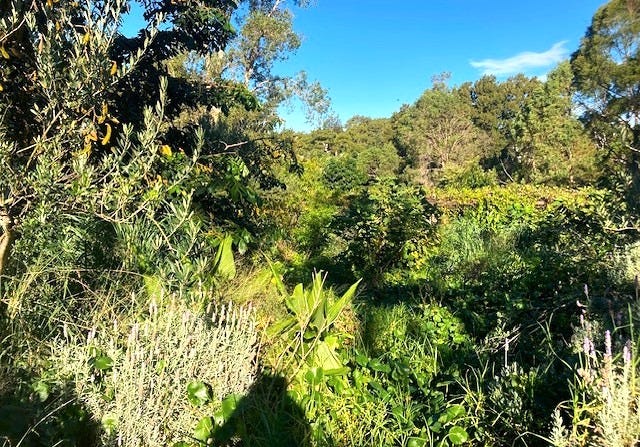
When it was planted out nearly eight years ago, swales and berms were shaped into the Forest’s eastward facing slope. This simple landscape technology of mounds and trenches works well to slow and capture rain. At its lowest point, the Forest is muddy but not flooded. But our adjacent community garden is not so hardy. Rains pour down muddy paths flooding the lowest plots. There is talk of installing pipes which will push the rain water out into the park but I am not convinced that this is a good solution. Thanks to what I am learning as a volunteer in the Food Forest, I am morphing into a ‘permie’, a follower of permaculture philosophy and practice.
Permaculture is all about keeping resources on site rather than disposing of them as waste. In the Food Forest we ‘chop and drop’ branches and uproot weeds, leaving them to rot on the ground to mulch and feed the soil. Similarly, we work to retain water on site through the practices of ‘slowing, spreading and sinking’. Studying the water run offs in our Community Garden, I plan a series of mini swales and berms on the muddiest path.
A month ago, my fellow plot holder Keri, and I constructed a prototype swale and berm on the pathway . The berm is planted with comfrey whose long roots will help hold the soil together, while the swale holds strawberry plants which we hope will convert rainwater to juicy fruit. As soon as we installed our makeshift experiment, the rain came down. To my delight even this one small berm and swale seemed to reduce the flooding below so now we need to dig some more. But right now, our focus is on laying down mulch and raising shade cloth above our garden beds as temperatures soar way above average for spring.
The community garden holds a repository of experience about how to keep growing through drought and rains. I have learnt from others the wisdom of growing more perennials, like asparagus, Jerusalem artichokes, turmeric, and sweet potato which hold and feed soils through all seasons. In summer, beneath their shading foliage, I plant lettuces and salad greens. Once these do bolt, I have learnt from permaculture to leave the roots of these annuals in the ground so their mycorrhizae can flourish awhile longer helping to store water and cool surface temperatures, sustaining worms and earth.
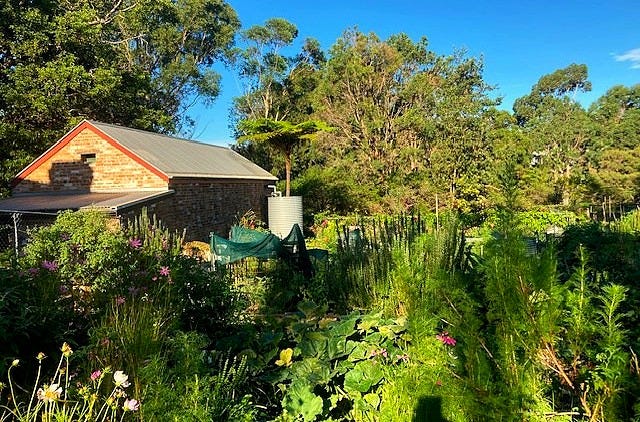
Permaculture’s first principle is to observe and interact. This lays the groundwork for identifying opportunities and connections, as well as responding to what’s needed. Ecosystems teach us that even extreme and unwelcome weather events can serve as catalysts for positive change as well as unleash tragic consequences. My friends at Bushfire Survivors for Climate Action, many of whom have lost homes and beloved places in recent bushfires, are proof in action of this human life. Over the last 7 years they have created an effective national climate action group, developing their advocacy skills and running climate cases in court, while giving support to one another as they rebuild their own homes and lives. There are no silver linings or compensation for the immense losses of bushfires and other disasters, but there are creative and effective responses which engage with the reality on the ground, finding openings within the challenges.
Each extreme weather event creates pressure to build what resilience we can into our souls and soils. Similarly, challenging and extreme current events call us into action for the benefit of communities, human and other-than-human. With so many Governments walking away from their duty of being good stewards of lands and life, the need for each of us to take up this mantle of care is ever more urgent. Permaculture can be a good teacher in this: accepting the challenges as they are, observing and interacting with whatever presents, caring for planet and people, spreading, sharing, saving and savouring the essential elements of life, from water, food and seeds through to relationships, community networks and knowledge.
Connecting to others strengthens social fabric, defying modernity culture’s predilection for isolating people. Getting to know our neighbours, volunteering at local schools and community centres, hosting toy swaps, attending book clubs or potluck dinners are all ways of thickening the weave of social cohesion. This is what our times and conditions call us into, nurturing life forces, especially where they are under attack. Life begets life, always evolving. Whatever circumstances are visiting our lives and communities, presents the raw materials for collaborating with life, creatively responding to what is here.
The first step towards regenerating our world starts at our doorsteps. Permaculture advises us to start small and go slow, observing and connecting as we go. What is it you can do today to strengthen the weave of the ecological and cultural fabric of your places? Take a look around. What possibilities can you see for growing life and connections in your home, neighbourhood, or workplace? Perhaps growing native vegetation on a street verge to increase biodiversity, setting up a community pantry for those living with food insecurity , organising a creek cleanup day or starting a workplace compost system. Not every experiment will be a wild success, but each one weaves us a little more into the places we inhabit, responding to our times by nurturing life through thick and thin.
Thank you for planting the goodness you do. It's bearing fruit and hope far and wide. <3
I always enjoy your words, Sally. Thank you for sharing your lived experiences with us here. And thank you also for the questions you ask at the end. Lots of food for thought today. I am fairly new in the area where I live and am always asking how I can weave myself further into the fabric of this place in a way that is beneficial to the land, the animals and the people that live here.