
Living Stories
In conversation with Dominique Hes and Caroline Pidcock

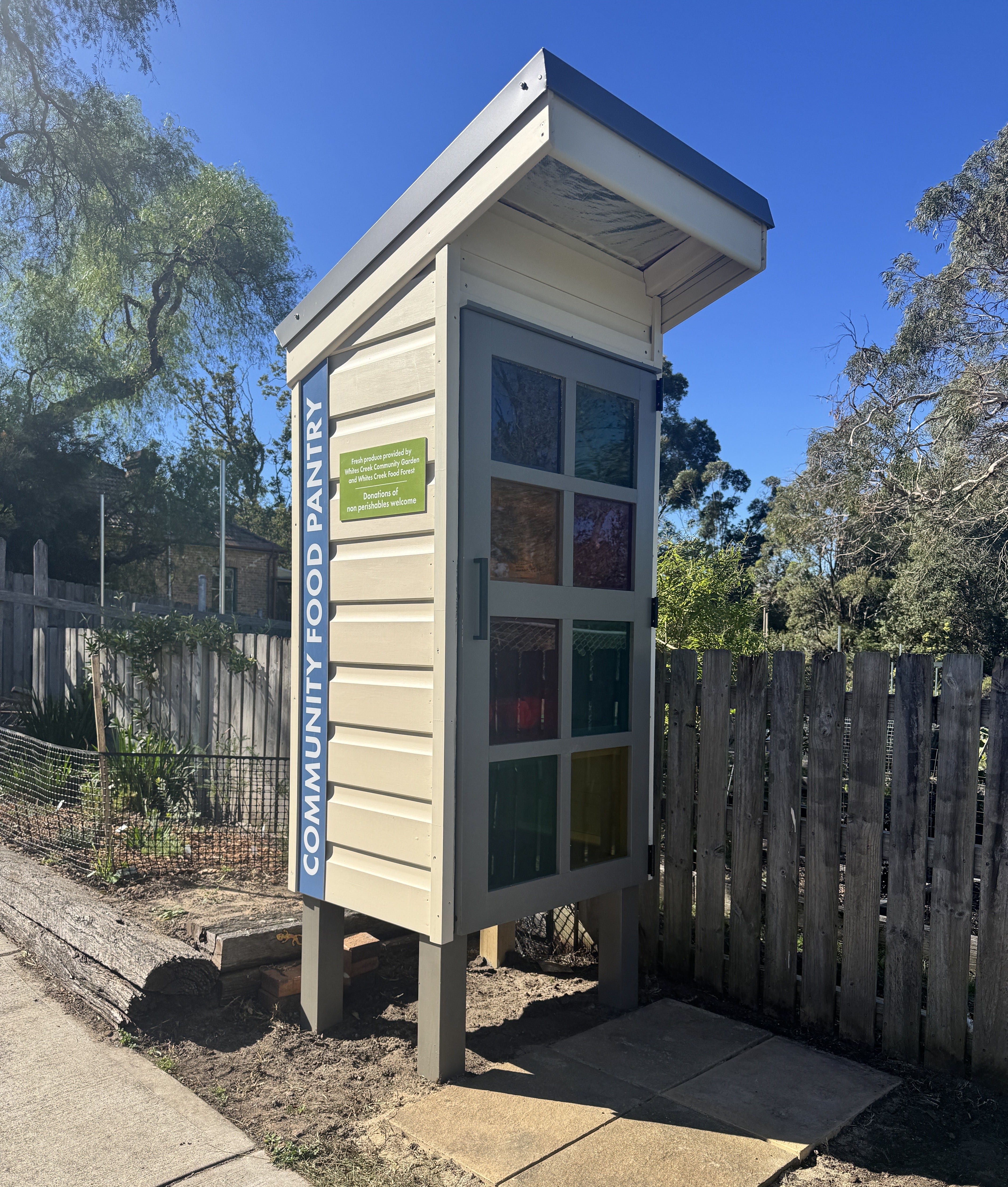
My Community Garden’s new Food Pantry is up and running. It’s a beautifully built street cupboard, the passion project of one of our gardeners well-supported by other volunteers. A few weeks back we had an opening ceremony and party. After cutting the red ribbon, we stocked the shelves with fresh and canned fruit and vegetables. Within two days the cupboard was almost bare.
Then the magic kicked in. Bunches of parsley, limes, Warrigal greens (native spinach), rhubarb, bush tomatoes arrived from the Garden and Food Forest. So too did gifts from the wider community: shortbread biscuits, lemon chutney, tamarind paste, a box of rose scented soap, and a set of Pokemon cards. Our pantry is growing a gift economy, energising our community’s store of generosity fed by the story of sharing.
Community is on many people’s minds at the moment. Both because we yearn to repair the isolations of the hyper-individualism mainstream culture and because grassroots change beckons in a time when Governments disappoint so many. Listening recently to the Permaculture Education Institute’s online Festival of Wild and Kind Ideas (replays free online), hosted by Morag Gamble, I heard remarkable stories of ingenuous local initiatives which nourish and strengthen urban, rural and even war-torn communities around the world. Everything was on the menu: enriching soils, restoring watersheds, growing food, saving seeds, developing co-operative governance systems and cultivating caring cultures, all shared under the umbrella of permaculture’s credo of Earth Care, People Care and Fair Share.
Also attending the Festival were two of my new friends from the Confluence canoe trip, Caroline Pidcock and Dominique Hes. Caro is an architect with decades of experience contributing to a wide range of boards and organisations, while also leading sustainable architectural design, advice and thinking in Australia and internationally. Dominique is an author, educator, policy advisor and regenerative thinker focused on biophilia (human connection to nature) and eco-friendly building and design practices. Together these two innovators co-founded (with a number of others) the Living Future Institute of Australia (now Living Future Oceania) an affiliate of the International Living Futures Institute which supports the creation of communities that are socially just, culturally rich and ecologically restorative. Between them, Dominique and Caro have a huge repository of experience doing just this, which I am keen to learn more about, so we made a time to meet up after the Festival.
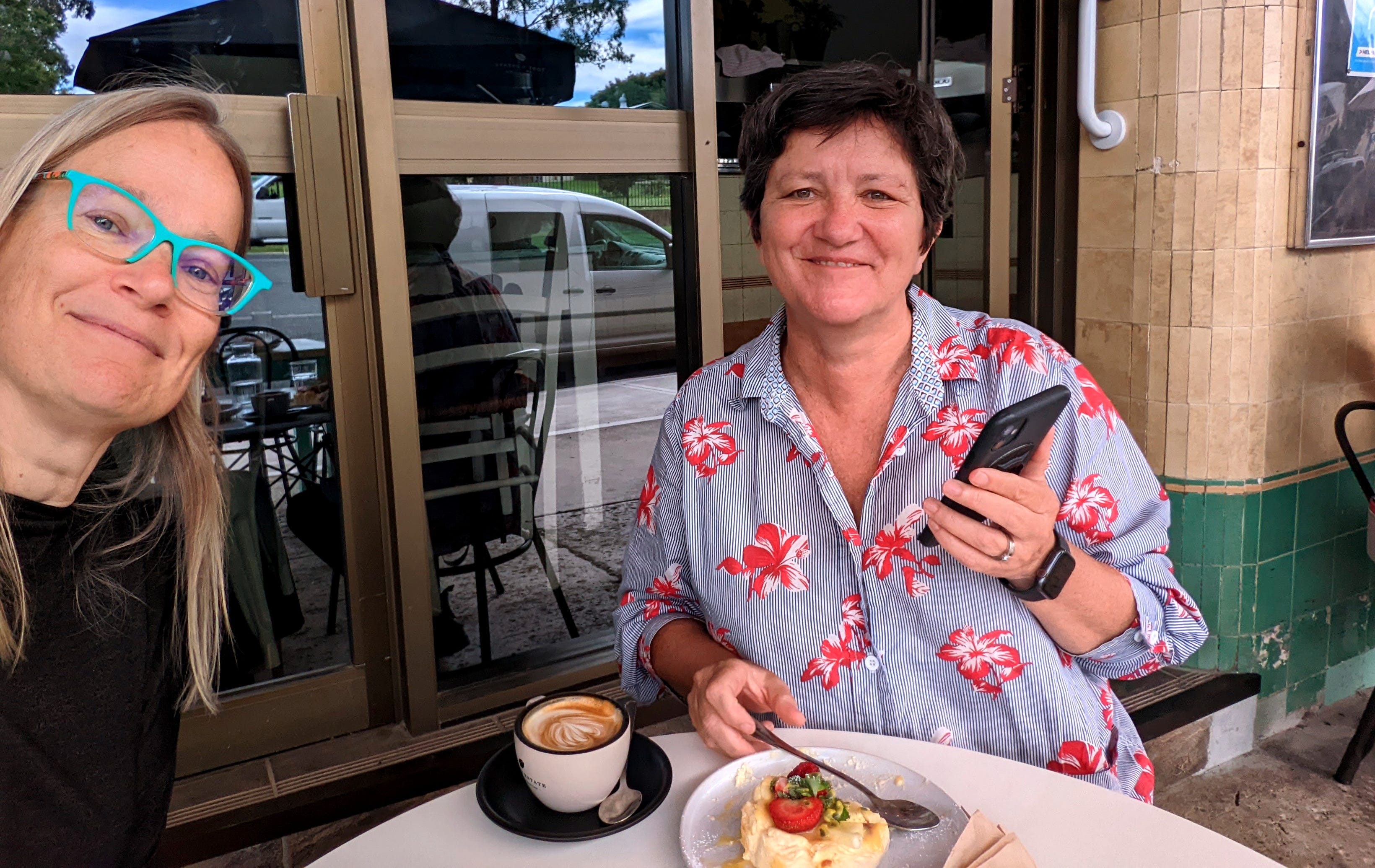
After chatting about what inspired us at the Festival (pretty much everything), we talk about what they have been working on since our travels together. Dominique has been writing a powerful Substack series called ‘From Stuff to Story’. With her background in science, engineering and architecture, Dominique knows all about the ‘stuff’ of sustainable and regenerative practices but now her focus is on sharing stories to activate systemic change, having been deeply inspired by both David Korten’s Change the Story, Change the Future and Tyson Yunkaporta’s Right Story Wrong Story. She explains:
Economics, law. planning, education and government and how we see government, is all potentially wrong story leading to a whole lot of focus on stuff, … We can’t face this story, so we focus on the stuff, thinking that this means we are succeeding. But if we were to just face the story and say, “oh, this is wrong story”, and then find the right story. For me, this is relationality with the living world which requires the building of the right brain, because we’ve lost it through over focusing on mechanistic, linear and reductionist thinking [from the left brain].
Reflecting on many of her past projects, Dominique recognises that while the focus has tended to be on stuff, story has always been there too. Dominque tells me how her pioneering work in regenerative communities began with a terrible personal story in 2009, when a young engineering student took his life: She remembers:
I felt so…discombobulated by the fact that this 19-year-old saw no hope in the future, because of peak oil and stuff and had given up. I’d done a science degree, an engineering degree, an architecture. PhD, and none of this was giving me the answers that I needed. I thought then it’s in regenerative development, and how it creates a narrative of hope that’s needed.
This insight propelled her to write the book Designing for Hope (e-book free for short time) as well as to commit to being a part of the creation of “a really thriving community where people would feel belonging and attachment and would care for Country.” This took the shape of an award-winning eco-village, The Paddock in Castlemaine, Victoria. One important part of this project were the regular citizen science surveys undertaken before the design was finalised. Now it’s completed, the residents are continuing on this work, much to Dominique’s delight. Recently when she met with them, she told them how a patch of Sweet Bursaria, the feeding ground of the Eltham butterfly was mistakenly removed by the builder. Within a week she heard back that the residents had sourced and planted this bush back where it was meant to be. Dominique tells us:
… to me THIS is the story. The residents now have the agency and caring for Country. We can walk away and it’ll be fine because they’ve got this!
Caro responds that the best “storytelling is where you can see yourself as part of that story, or…see how that story might go onto you” She tells us how her life now has been seeded by being part of the story of the design and build of First Steps Count, an innovative Child and Community Centre in Taree, New South Wales which has won awards and set new standards in sustainable architecture. While working with the integrated design team on this project, Caro heard about Dungog, a small thriving town not far away. Within a few years she moved there from Sydney, drawn by an inviting story of becoming an active participant in regional community. Now she is living this story, fully involved with the life of the town and its Country.
Through her work promoting sustainable, climate-aware architecture, Caro has learnt that “the way to change a system is through changing mindsets, not just the rules and frameworks.” She observes:
At the moment, most of the mindset in the sustainable movement is about doing less harm, reducing your footprints, so the focus then is always on the harm that you’re doing.
Caro is keen to counter this mindset. For the last few years, she has been developing Handprints as a way to help projects ask questions about the good they could create in the world, inspired by Gregory Norris of Harvard. She explains to us how Handprints helps to hold a story of flourishing by assigning positive contributions that can arise from projects or actions to each of the hand’s five fingers, this part inspired by Tyson Yunkaporta. Caro lists Handprint’s five key questions of regenerative design off on her own fingers for us:
1. How does what you do bring the story of place to life?
2. How does it celebrate resourcefulness?
3. How does it enable communities to thrive?
4. How do you foster the ‘long now’ thinking and habits of Good Ancestors?
5. How do you inspire and enable capacity and agency?
The three knuckles of each finger then hold clarifying questions which you can check out here.
Handprints’ questions are not about telling people what to do, says Caro. Instead, they provide a spring board for diving into systemic thinking whether it be in relation to a project or a life. I love how this approach recasts the climate narrative from a framing of individual harm and guilt to an invitation into collective agency and creative outcomes.
Reflecting on the Handprint of our new Community Pantry, I see that all five fingers are present in some way or another. Its design is beautiful, functional and sustainable, while its story is nourishing, enlivening and empowering to community in ways that reflect this continent’s First Nations cultures more than the ‘me first’ culture of modernity. The Pantry’s story has also become a catalyst for other initiatives. Last weekend when I wandered down to the garden, I was surprised to find four of the men who helped build the pantry, working hard to replace our shed’s dodgy disintegrating ramp with a sturdy safe one. As the Garden Co-ordinator, I hadn’t had to organise a working bee, or ask for volunteers. This was a completely self-organised project, a testament to the growing story of community contribution and care blossoming in our garden.
I leave my conversation with Caro and Dominique feeling immensely heartened by our sharing of stories and the positives of the projects we collectively hold. I wonder what agency and care are in your hands right now, and how some of the stories you live by might be rippling out into the communities around you? What is it like to identify the good you bring or pass on to where you live and work ? Caro, Dominique and I would love to hear some of the stories that are taking root in you and your circles.
Wonderful, Sally. You and this story are my answer to your questions! Read of the day
What wonderful women, and yay the food pantry and the garden. To read this inspires and delights. My current way of being/living becomes more and more simple, what joy x